Getting your analytics talent strategy wrong doesn’t just cost money. It slows decisions, weakens execution, and quietly erodes your competitive edge.
Market Research firms or Corporate Insights teams know the risks can be especially high for the business and the people involved.
Many top executives are struggling with this kind of decision in almost every industry. Should they develop an analytics team internally? Hire consultants? Or, perhaps, take the best of both worlds? At first, these options seem fine until you really think about what happens when the situation gets tough.
Nowadays, advanced analytics is no longer a mere support function. It drives pricing, customer experience, sales, and impacts operations. Selecting the wrong talent model will lead either to overpayment for seldom-used skills or to underinvestment in know-how that is lost when people leave the company.
The Three Options, Stripped Down
| Model | Best For | Risk | Cost Pattern |
| In-house | Long-term capability | High upfront | Fixed |
| Consultants | Short-term speed | Knowledge loss | Variable |
| Hybrid | Scaling + flexibility | Misalignment | Mixed |
In-house teams: In-house teams are dedicated to working directly with your data. They know the background of your business, its peculiarities, and the strategy for the long run. They are able to change directions quickly and keep the analytics in line with the changing goals. Instead of being a cost during outsourcing, they turn into a cost-efficient source of analytics over time.
Analytics consultants: Analytics consultantsoffer deep expertise in a particular area and a new point of view. They adjust their numbers to the level of project requirements. They work rapidly because they are already familiar with the problem. Their price is lower than a complete in-house team buildout, from scratch at the beginning.
Hybrid models: Hybrid models combine the use of consultants for complex time-sensitive projects with the building of internal ownership at a slower pace. A lot of businesses here begin by using the external knowledge and then change to in-house control.
Where Each Model Works and Where It Breaks
In-house teams perform best when advanced analytics becomes a general client expectation, and you have the volume of work projected that is well in excess of current consultant fees. If you require an ongoing investment in internal proprietary capabilities, a deep understanding of the company, or a very close integration with sensitive data, in-house talent is the most advantageous. They can work closely with your whole team and clients seamlessly.
However, they are more expensive initially. Salaries start at six figures, and on top of that, there are benefits, training, infrastructure, and overhead. Hiring takes time. If needs increase in an unplanned way, you will either have capacity gaps or have to pay for idle time.
This is especially true if you need to have the analytics expert be client-facing in any way and act as a consultant internally to teach, train, guide, and build.
Consultants are great for short-term projects, fast results, or when you don’t have the necessary internal skills. They have industry experience in choice modeling solutions, segmentation, and helping to identify the best approaches, and can start analytics from scratch. For changing demand, they provide flexibility without fixed costs.
Their limitations? They may not have long-term alignment. They don’t gather institutional knowledge. And project rates can be high. Hourly rates vary between $150 and over $1, 000. Costs go up if engagements are longer. If a consultant quits in the middle of the project, you are left with no one.
Hybrids seem to make sense, but there is a risk of becoming permanently dependent on consultants or doubling your costs without any clarity on where the boundaries are.
The Tradeoffs That Actually Matter
Speed: At the beginning, consultants can deliver more quickly with their easy-to-use frameworks and tools. In-house teams have to be given a chance to get up to speed, but after they are fully integrated, they can react more quickly to changes in priorities.
Flexibility: Consultants grow with the demand. In-house teams can change business needs without having to renegotiate contracts or explain the context from scratch.
Knowledge retention: In-house teams are the clear winners here. Every new investigation is based on the previous one. The context accumulates. Consultants depart when contracts are over, taking their knowledge with them. However, you can pick consultants who build internal knowledge and skills if they are educationally oriented.
Risk: There is a risk in execution when you build in-house, e.g., wrong hires, underestimated infrastructure needs, and bandwidth issues. On the other hand, consulting carries vendor risk dependency, misalignment, and lost timeline control.
Common Mistakes Companies Make
Companies underestimate the cost of assembling their own team. It isn’t just about salaries; it also includes training, tools, overhead, and the cost of missed opportunities. Plan the finances for three years instead of just one.
Some people overestimate their analytics capability. They bring in consultants without really knowing what to measure. You can’t get clarity by outsourcing. Without having clear goals, even the best consultants fall short.
Some people make the mistake of thinking of analytics simply as hiring for dashboards, and then they wonder why they aren’t getting strategic insights. Analytics professionals need to be closely aligned with the business decision-making process, not hidden away in the organization.
A more subtle error: disregarding culture. If your company is not data-literate or is against decisions backed by analytics, no matter how skilled the external people are, they won’t be able to change that.
A Simple Decision Framework
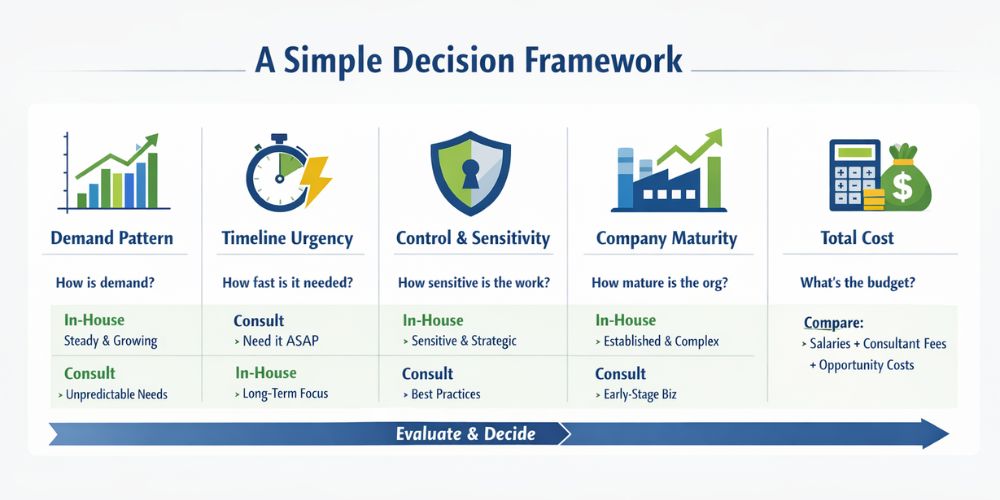
Let’s first go over demand patterns. If the demand is consistent and growing, you should make the role in-house. If you can’t predict the volume of work across differing projects and client needs, buying a consulting service is the right move. If you are growing very fast, a hybrid model may be a solution.
Next, check how important the timeline is. Do you want to get it done right away? Consultants are able to act more quickly. Most MR project work is episodic and short-lived. This argues for consultant use unless you have a clear future volume confidence.
Think about how much control you want over the strategy. If you are talking about sensitive data, you are going very deep with integration, or you are in competitive differentiation, then internal capabilities matter. If you only want general best practices, then consultants are fine.
Consider the level of maturity. It is very rare that early-stage companies need full analytics teams. But on the other hand, established enterprises with complex data do, and proprietary processes do. The turning point is when analytics changes from “nice to have” to “business, critical.”
Be honest with your budget. Don’t only think about salaries when calculating the total cost of ownership. Also, think about consultant fees over the expected duration. And don’t forget about opportunity costs.
The Bottom Line
At the Analytics Team, we see analytics talent as an evolving capability rather than a fixed staffing choice. Some organizations need to build internal depth to support day-to-day decision-making, while others benefit more from external specialists who can accelerate progress at key moments. In many cases, the strongest outcomes come from combining both approaches with clear ownership and defined boundaries.
What consistently matters is intentional design. Analytics delivers value only when the right skills are applied at the right time, and when knowledge is retained rather than lost between projects. A thoughtful mix of internal expertise and external support allows teams to move quickly without sacrificing long-term control.
If you’d like to explore which talent model best fits your current stage and data priorities, schedule a free consultation with The Analytics Team to evaluate your current analytics setup, identify gaps, and define the right talent model for your growth stage. We’ll help you assess options based on your goals, constraints, and the role analytics plays in your business decisions.