Every business wants customers to see its brand in a certain way. You may want your brand to be known for quality, value, innovation, or customer service. But your intended position is not the same as how customers see your brand. What matters is how they perceive it compared with competitors.
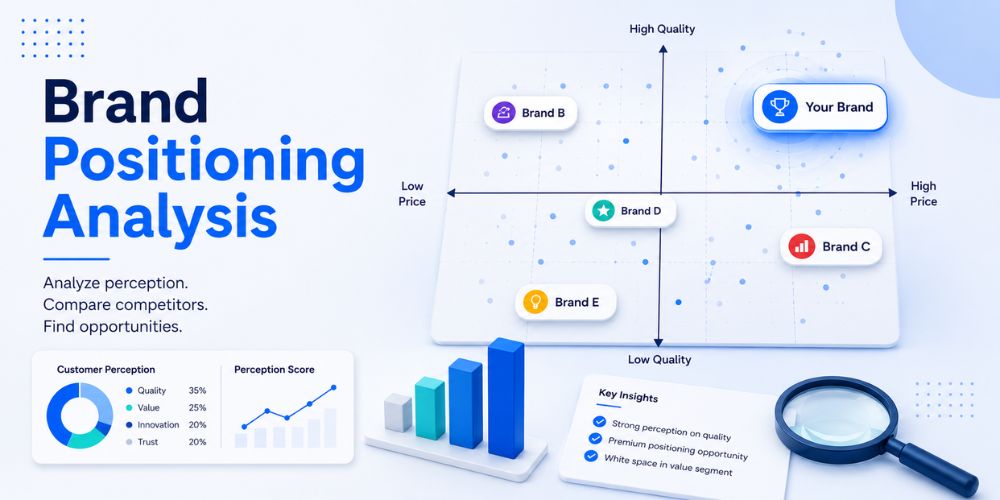
Brand positioning analysis helps businesses understand how customers see their brand compared with competitors. It shows where a brand is strong, where competitors have an advantage, and whether the brand is positioned as intended. This research can guide decisions about products, pricing, messaging, and competitive strategy.
Collecting customer feedback is only the beginning. The real value comes from knowing how to analyze brand positioning data and turn the findings into clear business decisions.
This guide explains how to analyze brand positioning data, which research methods to use, and how to turn the findings into better business decisions. It also covers common mistakes to avoid.
Why Brand Positioning Analysis Matters
Brand positioning analysis connects customer perceptions with business decisions. It can reveal competitive strengths, weaknesses, and areas that warrant further investigation.
- Brand messaging: Identify which qualities customers associate with the brand and use them to refine messaging.
- Product strategy: Find areas where customer needs are not being met or where competitors have an advantage.
- Competitive strategy: See how the brand compares with competitors on attributes that matter to customers.
- Pricing decisions: Assess whether customers’ perceptions of the brand and its value are consistent with its current or planned price position.
- Potential market opportunities: Identify areas where customer needs and competitor positions may warrant further investigation.
- Positioning changes: Track whether customer perceptions change after a new product, campaign, or other major market change.
The key is to connect the research to a specific business decision. A positioning study should not end with a set of charts or scores. It should explain what the findings mean and what the business should consider doing next.
What Data Do You Need for Brand Positioning Analysis?
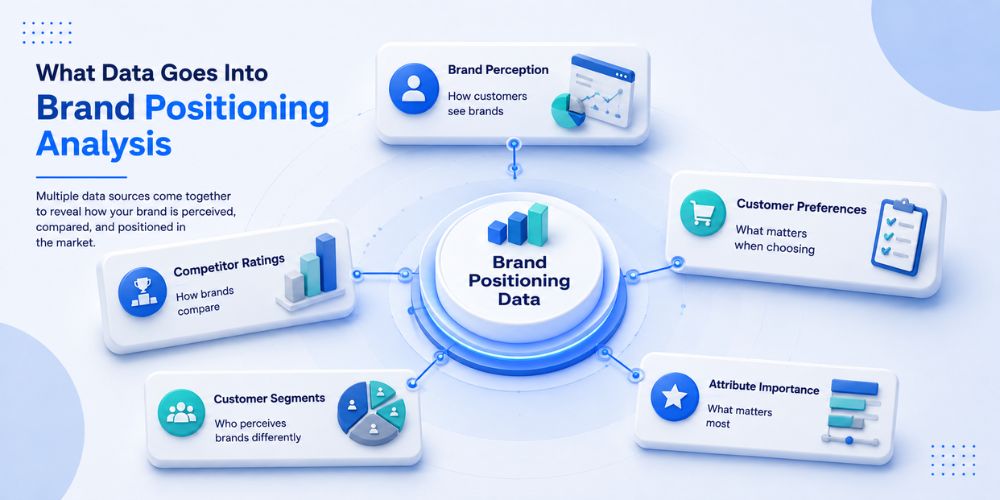
Before you can analyze brand positioning, you need data that shows how customers see your brand, how they compare it with competitors, and what they value when making decisions.
Start by defining the questions the research needs to answer. For example:
- How do customers perceive our brand compared with competitors?
- Which brand attributes matter most to customers?
- Which factors matter when customers choose between brands?
- Does customer perception match our intended positioning?
- Where are there opportunities to differentiate?
These questions determine what data you need to collect. A useful positioning study may include brand perception ratings, competitor ratings, attribute importance, customer preferences, and information about different customer groups.
The goal is not to collect as much data as possible. It is to collect the right data for the decision you need to make.
Brand Perception Ratings
Brand perception ratings show how customers view your brand on specific attributes. Respondents can rate your brand and competing brands on attributes that matter in your market, such as:
- Product quality
- Value for money
- Innovation
- Reliability
- Customer service
- Ease of use
- Trustworthiness
These ratings help you see where your brand performs well and where it may fall behind competitors. They also provide the basic data needed to compare customer perceptions across brands.
Competitive Comparisons
To understand your position in the market, compare your brand with the brands customers are most likely to consider as alternatives.
Use the same attributes and rating scale for each brand. This makes the results easier to compare and can show where your brand performs better, where competitors have an advantage, and where several brands are perceived in a similar way.
This is an important part of competitive positioning research because a strong score on its own does not necessarily mean a competitive advantage. What matters is how that score compares with the alternatives customers see.
Customer Preferences
Knowing how customers rate a brand is not enough. You also need to understand which attributes matter when they make a choice.
For example, customers may rate two brands similarly on quality but choose between them based on price, reliability, or customer service. Measuring attribute preferences helps explain what matters most when customers compare their options.
This data adds another layer to brand positioning analysis. It helps businesses distinguish between attributes that look important in brand ratings and those that matter when customers compare their options.
Customer Segments
Brand perceptions can vary across customer groups. A brand may have a strong position among loyal customers but a weaker position among new or potential customers.
Analyzing the data by customer segment can reveal these differences. For example, one group may associate the brand with quality, while another may value its price or convenience more.
This helps businesses see whether their positioning works consistently across the market or is stronger with certain customer groups.
How to Analyze Brand Positioning Data
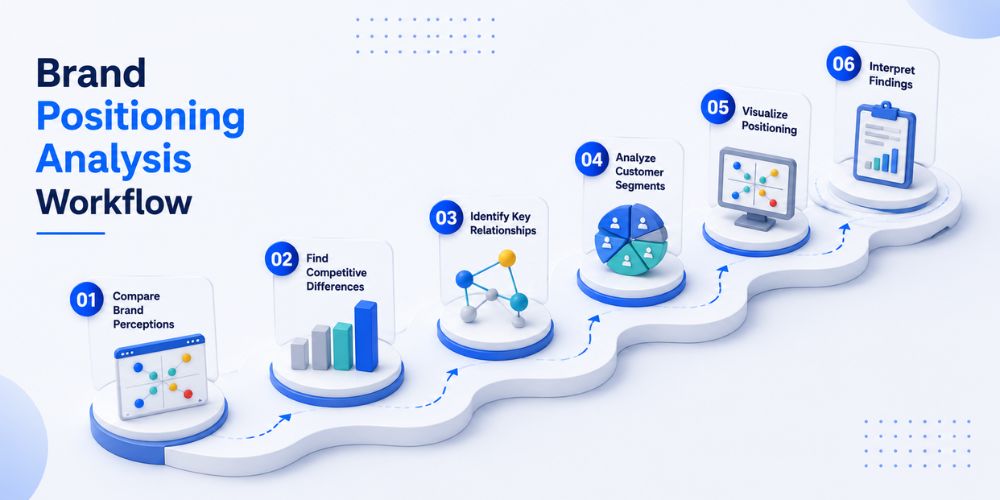
Once you have the right data, the next step is to find patterns that can explain your brand’s position in the market. The analysis should move from simple comparisons to deeper questions about what sets your brand apart, which attributes are associated with customer perceptions, and where there may be room to improve.
A practical approach is to work through the data in six steps.
1. Compare Brand Perceptions
Start by comparing how customers rate your brand and its competitors across the attributes measured in the research.
Look for clear differences between brands. Pay attention to both strong and weak ratings, but also consider how large the differences are. A small lead on an attribute may not matter if customers see little difference between the brands.
The goal at this stage is to identify the main patterns in how customers view each brand.
2. Assess Which Differences Are Meaningful
Look beyond individual scores and ask what makes your brand different from its competitors.
For example, your brand may score highly on quality, but if competitors receive similar ratings, quality may not give you a clear advantage. A lower-rated attribute may also reveal an area where your brand is falling behind.
This comparison helps turn raw survey results into a clearer picture of your competitive positioning.
3. Identify Attributes Related to Brand Perception
Not every attribute has the same effect on how customers view a brand.
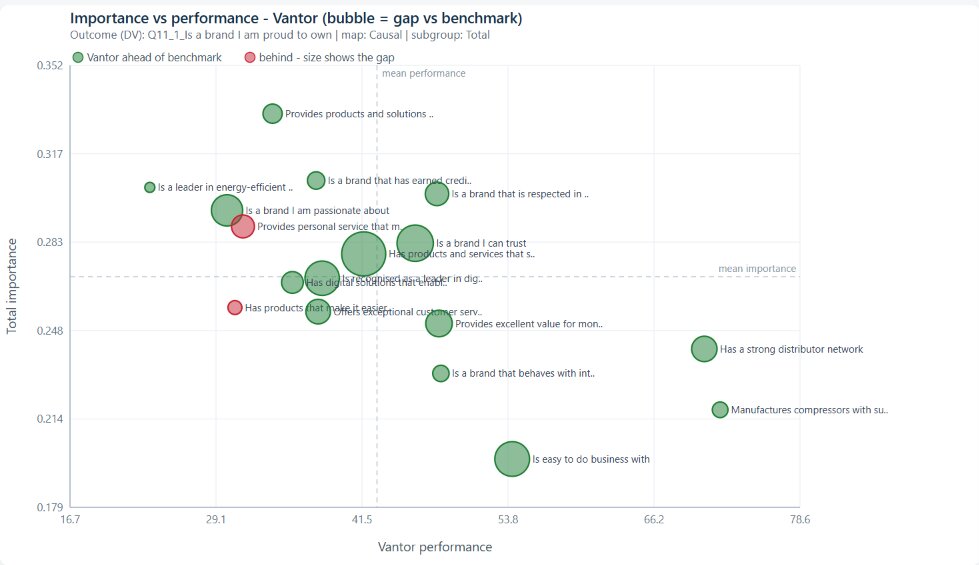
Driver analysis can identify the attributes most strongly associated with brand perception. Driver Maps can take this further by showing how those drivers relate to one another. They can also be combined with relative competitive performance. This adds context by showing where your brand performs above or below the main competition and how large those differences are.
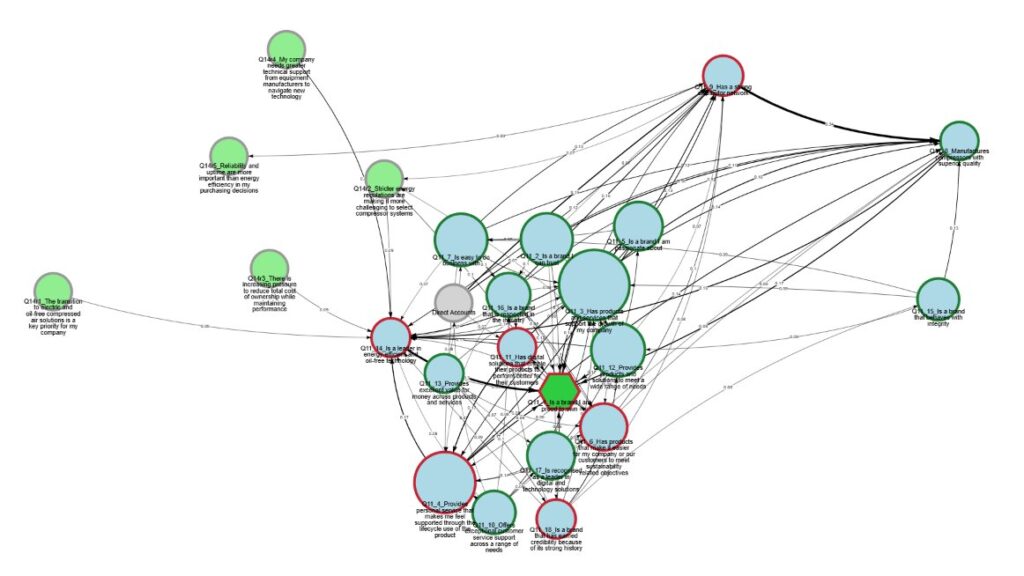
This added context helps research teams distinguish important competitive gaps from areas where the brand is already performing well.
4. Look for Differences Between Customer Groups
The overall results can hide important differences between customer groups.
Analyze the data by relevant customer segments to see how perceptions differ across groups. For example, loyal customers may view a brand differently from potential customers, or one customer group may value an attribute that another group considers less important.
This can show whether your positioning is consistent across the market or stronger with specific audiences.
5. Visualize the Competitive Position
Once the main patterns are clear, use visual analysis to make the results easier to understand.
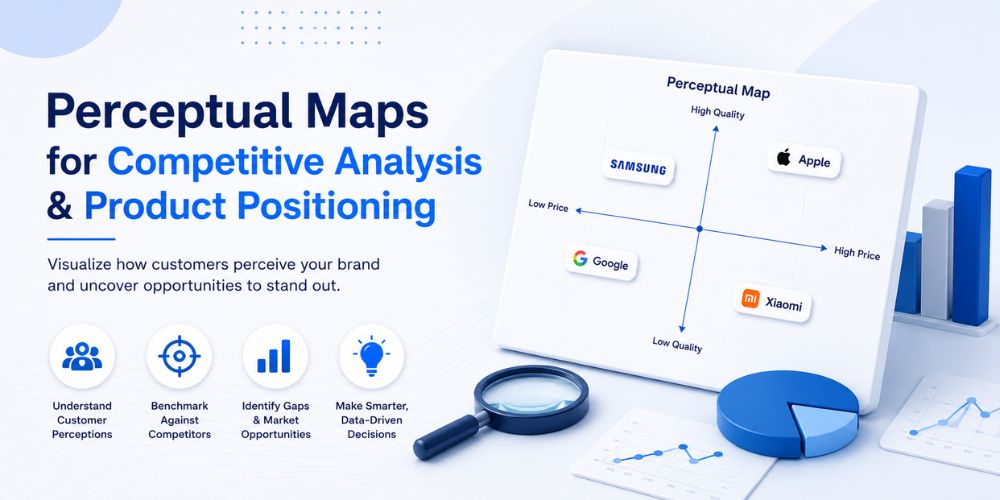
A perceptual map can show how customers position brands relative to one another across selected attributes. It can make clusters, similarities, and differences easier to see than a table of scores.
Perceptual maps can also be enhanced with importance data. By varying bubble size based on attribute importance, the map can show not only where brands are positioned, but also which attributes matter most to customers.
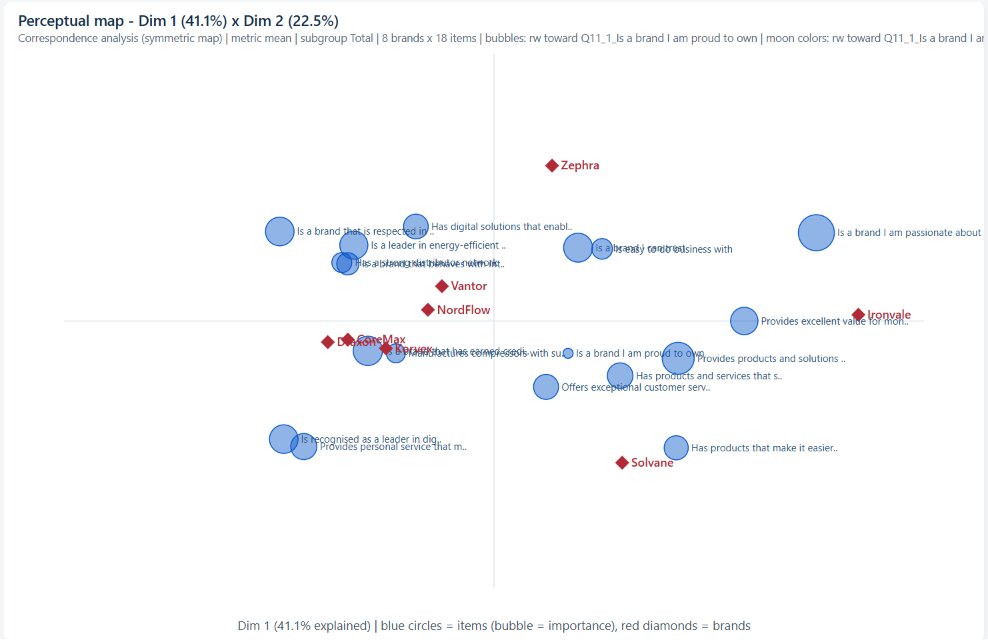
Use the map to support your analysis rather than treating it as the final answer. The important question is what the pattern means for the brand and its competitive position.
6. Connect the Findings to Business Decisions
The final step is to turn the analysis into clear recommendations.
Some analyses can go beyond identifying where a brand should improve. A Next Best Change (NBC) approach combines perception and importance data to explore which changes may have the greatest potential impact. It can also consider how the order of changes may affect the result.
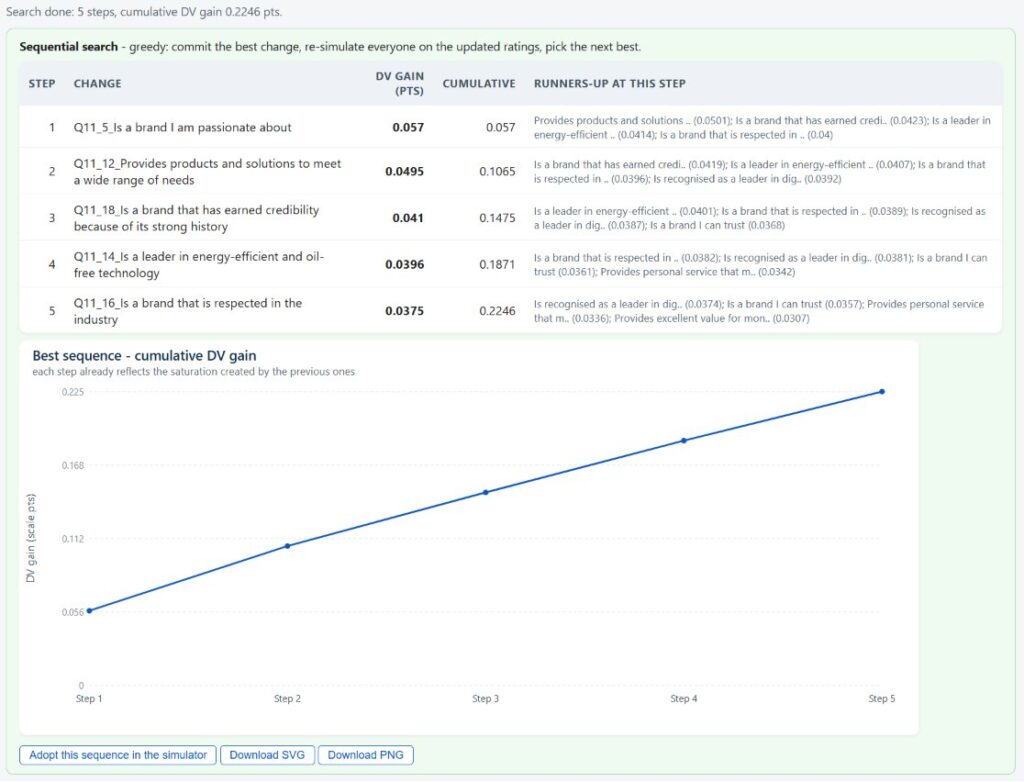
Depending on the findings, this could mean:
- Refining brand messaging
- Improving a product or service
- Changing how the brand is differentiated
- Reviewing pricing
- Focusing on a specific customer group
- Addressing a competitive weakness
The recommendation should follow from the evidence. If the research shows that an attribute matters to customers and your brand performs poorly on it, that gives the business a clearer reason to act.
Analytical Methods Used in Brand Positioning Research
Different methods answer different positioning questions. The right choice depends on what you need to learn from the research.
For example, you may want to understand how customers see your brand, what shapes those perceptions, how views differ across customer groups, or how changes to a product may affect customer choice
Here are four methods that can support different parts of brand positioning research.
Perceptual Maps
Best for: Comparing how customers perceive brands.
A perceptual map turns brand perception data into a visual map. It helps teams see how brands are positioned relative to one another and makes similarities and differences easier to spot.
Use it when you need a clear view of the competitive landscape.
Read more: Perceptual Maps for Competitive Positioning Strategy
Driver Analysis
Best for: Identifying attributes associated with brand perception.
Brand ratings tell you what customers think. Driver analysis can help show which attributes have the strongest relationship with overall perception.
This can help businesses focus on the factors that are most important rather than treating every attribute as equally important.
Read more: Driver Maps
Customer Segmentation
Best for: Comparing perceptions across customer groups.
Overall results can hide differences between customer groups. Segmentation helps you examine whether different groups see the brand in different ways.
This can reveal which customer groups perceive the brand differently and where the current positioning may be stronger or weaker.
Learn more: Customer Segmentation Consulting
Conjoint Analysis
Best for: Testing product and pricing choices.
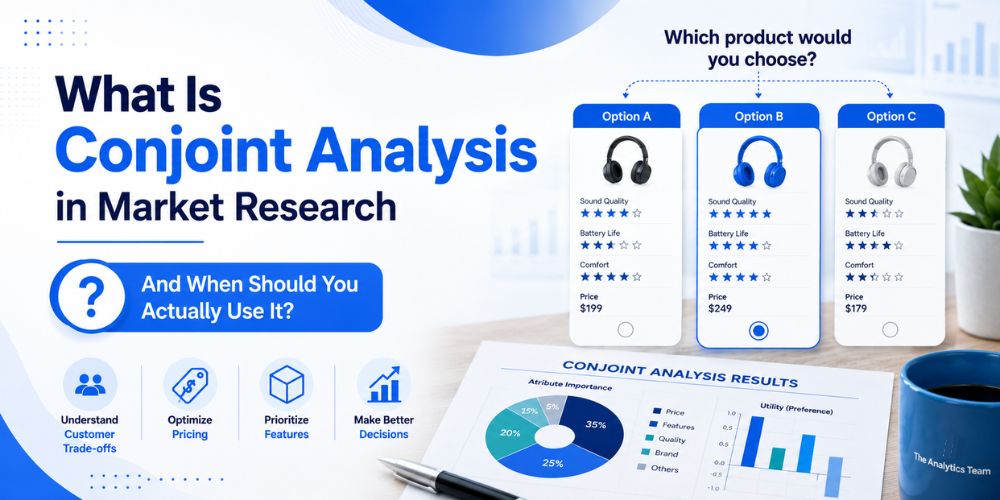
Conjoint analysis evaluates how changes to a product, feature, price, or brand may affect customer choice.
This makes it useful when you want to evaluate trade-offs between different product, pricing, and brand options before making a decision.
Read more: Conjoint Analysis in Market Research
Choosing the Right Method
The best method depends on the question you need to answer:
| Question | Method |
| How do customers perceive competing brands? | Perceptual Maps |
| Which attributes are associated with those perceptions? | Driver Analysis |
| Do different customer groups see the brand differently? | Customer Segmentation |
| How could product or pricing changes affect choice? | Conjoint Analysis |
These methods can also be used together. For example, a study could use segmentation to identify important customer groups, perceptual maps to compare their brand perceptions, and driver analysis to understand what shapes those perceptions.
How to Identify a Positioning Gap
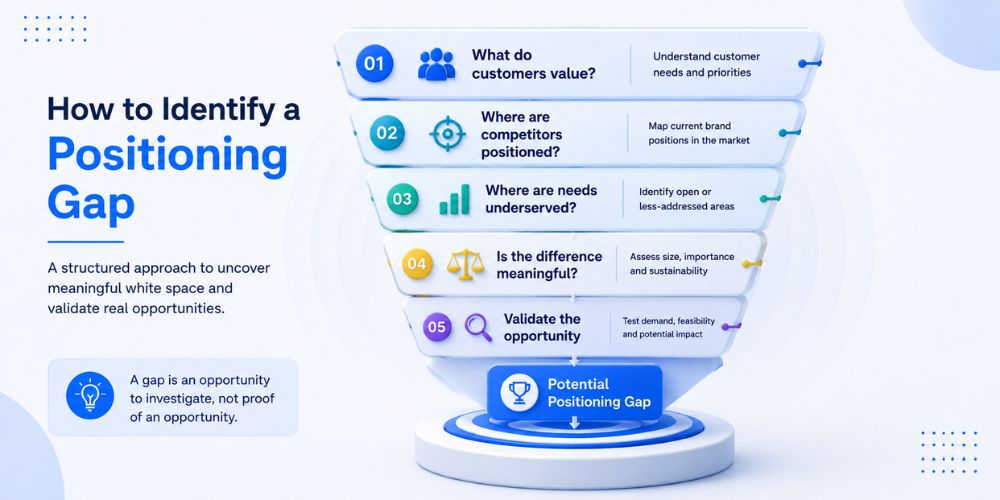
A positioning gap can appear when customers value something that competing brands do not strongly own. But an empty space in the market is not automatically an opportunity.
To identify a useful positioning gap, look at several parts of the research together.
1. Identify Important Attributes
Start with the attributes that matter most to your target customers. A gap is more relevant when it involves something customers actually value.
2. Compare Competitor Positions
Look at how strongly each competitor is associated with those attributes. Some positions may already be crowded, while others may be less strongly owned.
Go beyond performance alone by combining importance with competitive performance. Competitive performance-importance analysis can show how important an attribute is, how your brand performs, and where competitors have an advantage. This helps distinguish simple differences from gaps that may require attention.
3. Look for Unmet Needs
Consider whether an important customer need is poorly addressed by the current market. This can reveal areas where a brand may be able to offer something different.
4. Check the Size of the Gap
A small difference between brands may not represent a meaningful opportunity. Look for differences that are clear and supported by the research.
5. Validate the Opportunity
A potential gap still needs to be validated. Customers must value the position, and the business must be able to deliver it in a credible and sustainable way.
A perceptual map can help reveal possible gaps, but the map should be used alongside the wider research. An empty space on a map is a starting point for investigation, not proof of a market opportunity.
How to Track Brand Positioning Over Time
Brand positioning can change as customer expectations, competitors, products, and marketing change. Tracking the same key measures over time can show whether customer perceptions are moving in the desired direction.
For useful comparisons, keep the main research measures consistent where possible. This includes the target audience, key attributes, question wording, and measurement approach.
Compare results across research periods and look for meaningful changes rather than reacting to small differences. This can help businesses see whether customer perceptions have changed in the intended direction or are moving in another direction.
Common Mistakes in Brand Positioning Analysis
Good positioning research can still lead to poor decisions if the data is interpreted incorrectly. Some mistakes can make brands appear stronger or weaker than they really are, while others can hide important differences between customer groups.
Here are some common mistakes to avoid.
Looking at Average Scores Alone
An average score gives you a useful summary, but it can hide important differences.
For example, a brand may have an average quality score of 8 out of 10. That sounds strong, but the result may be very different across customer groups. Loyal customers may rate the brand highly while potential customers give it much lower scores.
Look beyond the overall average when the research includes meaningful customer groups.
Treating Every Attribute as Equally Important
A brand may receive high ratings for several attributes, but that does not mean all of them matter equally.
For example, customers may rate a brand highly for design and reliability. If reliability has a much stronger relationship with their overall view of the brand, improving design may have less impact.
Brand positioning analysis should therefore consider both how customers rate an attribute and how much that attribute matters.
Confusing Perception with Preference
Customers can view a brand positively without choosing it.
A customer might describe a brand as high quality but still prefer another brand because of price, convenience, or other factors.
This is why brand ratings should not be treated as direct measures of customer choice. Different research measures may be needed when the goal is to understand what drives actual choices.
Treating Customer Perception as Static
Customer perceptions can change as the market changes.
New competitors, product launches, price changes, advertising, and customer experiences can all affect how people view a brand.
If positioning is important to the business, measure it over time rather than assuming that today’s results will remain the same.
Mistaking a Visual Pattern for a Business Opportunity
A gap on a perceptual map does not automatically represent a market opportunity.
Customers may not value that position, or the business may not be able to compete there successfully.
Use the wider research to determine whether the gap reflects a real customer need and a position the brand can credibly own.
Drawing Conclusions From Small Differences
Not every difference between brands is meaningful. A small difference in ratings may be due to normal variation in the research rather than a real difference in customer perception.
Before treating a difference as a competitive strength or weakness, consider whether the evidence is strong enough to support that conclusion.
Stopping at Description
Another common mistake is reporting what the data shows without explaining what it means.
For example:
“Customers rate Brand A higher on reliability than Brand B.”
That’s a finding, but it is not yet a recommendation.
A stronger analysis asks:
Does reliability matter to the target customers, and does this difference affect the brand’s competitive position?
The goal is to move from what the data shows to what the business should understand from it.
Expert Insight
The goal is not to produce a report full of scores and charts. It is about finding the patterns that matter for the decision.
A useful analysis connects customer perceptions, competitive differences, and the factors that matter to the target customers. It also makes clear where the data supports a conclusion and where further research may be needed.
Turning Brand Positioning Analysis into Better Business Decisions
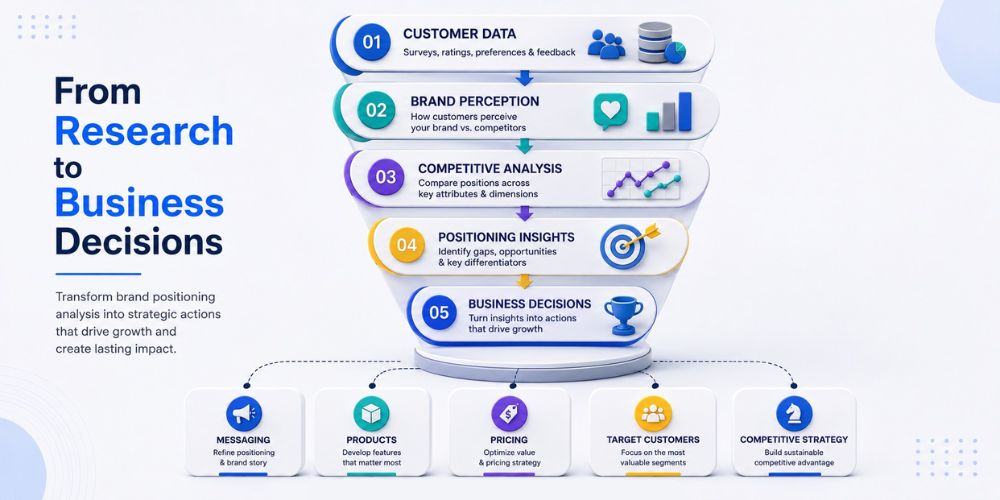
The value of brand positioning analysis comes from what you do with the findings. Once the research shows how customers view your brand and where it stands against competitors, those insights can guide specific business decisions.
Refine Brand Messaging
If customers associate your brand with qualities that differ from your intended position, your messaging may need to change.
For example, if you want to be seen as innovative but customers mainly associate your brand with reliability, your communication may need to do more to highlight innovation.
Improve Products and Services
Positioning research can show where customer expectations and your current offer do not match.
These findings can help product teams decide which features, services, or experiences deserve more attention.
Strengthen Competitive Positioning
Research can show where your brand has a clear advantage and where competitors are stronger.
Use these findings to decide where to defend your strengths, address weaknesses, or build a clearer point of difference.
Support Pricing Decisions
Customer perceptions can also inform pricing.
If customers see your brand as premium, the findings can help assess whether the price and value proposition support that position.
Prioritize Target Customer Groups
If positioning differs across customer groups, the business may need to focus on the audiences where its strengths are most relevant.
This can help guide targeting, messaging, and product decisions without assuming that the same positioning will work equally well for everyone.
Track Whether the Positioning Is Working
Positioning decisions should be measured after they are implemented.
Repeat research can show whether customer perceptions have changed and whether the brand is moving closer to its intended position. This turns positioning research into an ongoing way to evaluate and improve strategy.
For example:
Research finding → What it means → What should change → How to measure the result
This gives brand positioning analysis a practical role in product, pricing, messaging, and competitive strategy.
Conclusion
Brand positioning analysis brings together customer perceptions, competitive comparisons, and other research findings to understand where a brand stands in the market. It can show where a brand is strong, where competitors have an advantage, and whether the brand is positioned as intended.
The key is to look beyond individual scores. Good positioning research connects customer perceptions with competitive differences, customer needs, and the decisions the business needs to make.
The right analytical approach depends on the question. Perceptual maps can help visualize competitive positions, driver analysis can identify attributes associated with brand perceptions, segmentation can reveal differences between customer groups, and conjoint analysis can help evaluate trade-offs involving product, price, brand, and other attributes.
Ready to Turn Brand Positioning Research Into Clear Business Decisions?
We help market research teams and organizations analyze customer perceptions, evaluate competitive positioning, identify key drivers, and turn research data into clear business recommendations.
Discuss Your Brand Positioning Research With The Analytics Team.