Knowing what customers prefer is useful. But it does not always tell you which combination of products, features, or messages will reach the most people.
MaxDiff and TURF analysis combine two complementary approaches. MaxDiff helps identify what customers prefer, while TURF analysis evaluates which combinations can reach the most people.
Together, they can help market research teams move from individual preferences to stronger portfolio decisions.
What Is MaxDiff Analysis?
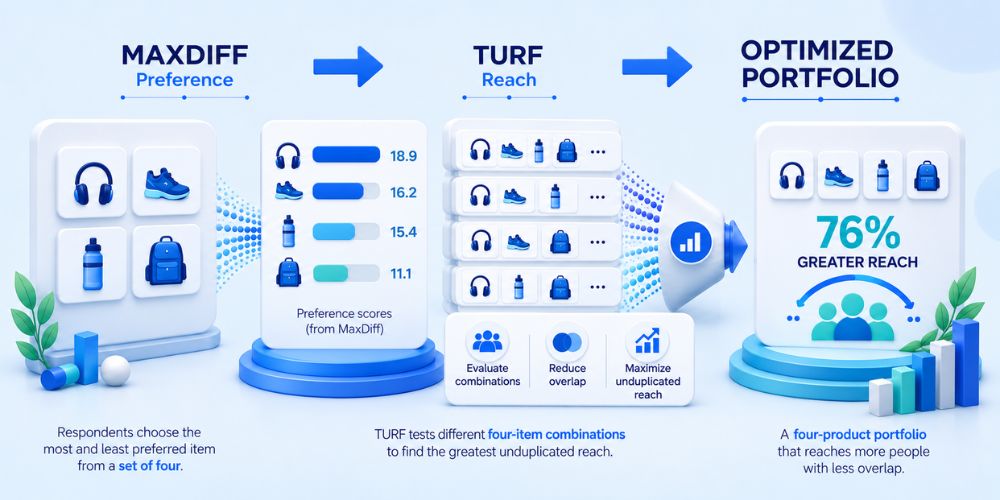
MaxDiff analysis measures relative preference by asking respondents to choose the most and least preferred item from small groups. In practice, MaxDiff choice sets are typically limited to four items per screen. Keeping the set to four gives respondents enough options to make meaningful trade-offs without adding unnecessary cognitive burden. A fifth item does not provide additional strength to the model estimation, making four a practical best-practice choice.
Repeated choices create a clear preference hierarchy.
Instead of asking customers to rate every item, MaxDiff makes them choose between competing options.
MaxDiff answers a simple question:
Which items do customers prefer most?
The result is a ranked set of preferences that can be used for further analysis.
What Does MaxDiff Tell You?
MaxDiff can show which individual items are preferred most.
For example:
| Item | Preference |
| Product A | 18.9% |
| Product B | 16.2% |
| Product C | 15.4% |
| Product D | 11.1% |
At first, the answer may seem obvious. Choose the highest-ranked items.
But there is a problem.
The most preferred items may appeal to many of the same people.
In practice, MaxDiff choice sets are typically limited to four items per screen. Keeping the set to four gives respondents enough options to make meaningful trade-offs without adding unnecessary cognitive burden. A fifth item does not provide additional strength to the model estimation, making four a practical best-practice choice.
Why the Highest-Ranked Items May Not Make the Best Portfolio
Imagine two products are both highly preferred.
If the same customers prefer both products, adding the second product may bring very little additional reach.
A less-preferred product could be more valuable if it appeals to a different group.
This creates an important distinction:
Individual preference is not the same as portfolio reach.
MaxDiff helps identify strong individual items. TURF helps determine how those items work together.
What Is TURF Analysis?
TURF stands for Total Unduplicated Reach and Frequency.
TURF looks at different combinations of items and calculates how many different people each combination can reach.
The goal is not simply to find the most popular items.
The goal is to find a combination that reaches the most people while minimizing unnecessary overlap.
TURF answers a different question:
Which combination can reach the most different people?
This makes TURF useful for product portfolios, feature selection, messaging, media planning, and other decisions where there are limited slots or resources.
How MaxDiff and TURF Work Together
MaxDiff and TURF analysis answer different questions, but they can work well together. MaxDiff identifies which items customers prefer, while TURF analysis evaluates which combinations can reach the most people.
TURF analysis can use MaxDiff data to evaluate different combinations of items and identify opportunities to increase unduplicated reach. This allows research teams to move from individual preference rankings to a broader view of which items work best together.
1. Measure preferences with MaxDiff
Identify which products, features, messages, or other items customers prefer.
2. Use the preference data
The results provide preference data for evaluating how different customers respond to each item.
3. Test combinations with TURF
TURF evaluates different combinations and measures their unduplicated reach.
4. Compare the results
The analysis can show whether the most popular items also create the greatest overall reach.
5. Identify the better combination
The result is a portfolio that combines customer preference with reach.
In simple terms:
MaxDiff tells you what people prefer. TURF helps you decide what to put together.
A Simple MaxDiff TURF Analysis Example
Suppose a company has 12 products but can offer only four.
MaxDiff identifies the products with the strongest individual preferences.
The company could simply select the four highest-ranked products.
But TURF can test other combinations.
For example:
| Portfolio | Reach |
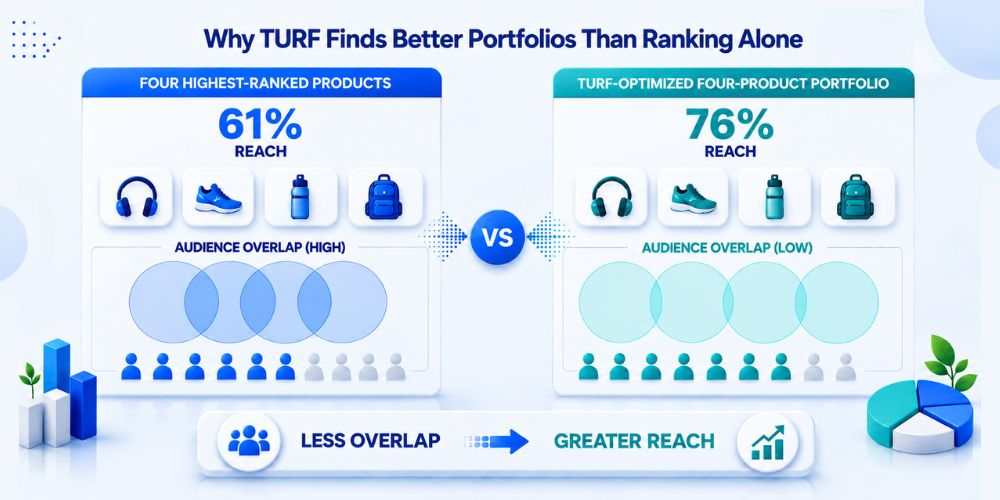
| Four highest-ranked products | 61% |
| Alternative combination | 74% |
| TURF-optimized combination | 76% |
The TURF result shows why ranking alone may not be enough.
The four most popular products reach 61% of the market, while the TURF-optimized combination reaches 76% because it reduces overlap between the products.
The best portfolio is not always the one with the four highest individual scores.
How TURF Finds Incremental Reach
TURF can also show how much each additional item contributes to total reach.
The first item may reach many people. The second adds more, but later items may contribute less if they appeal to people who are already reached.
But if the third or fourth item appeals mostly to people who are already reached, its incremental contribution may be much smaller.
This helps identify where adding another item stops creating meaningful additional reach.
The result can look like this:
Item 1 → Large reach gain
Item 2 → Strong additional reach
Item 3 → Moderate additional reach
Item 4 → Smaller additional reach
This helps teams understand how each additional item contributes to overall reach and where adding another item may stop creating meaningful incremental reach.
When Should Market Research Teams Use MaxDiff and TURF Analysis?
MaxDiff and TURF can be useful when you need to select a limited number of items from a larger set.
Product portfolios
Identify which products should make the final lineup.
Features
Find combinations of features that appeal to a broad customer base.
Messaging
Select messages or claims that can reach different customer groups.
Product assortments
Determine which products should receive limited shelf or menu space.
Campaign planning
Evaluate combinations of messages, offers, or other campaign elements.
The common problem is the same:
You have more options than you can use.
MaxDiff helps prioritize the options. TURF helps determine which combination provides the greatest reach.
MaxDiff vs. TURF
| MaxDiff | TURF | |
| Main question | What do people prefer? | Which combination reaches the most people? |
| Focus | Individual items | Item combinations |
| Output | Preference ranking | Portfolio options |
| Main value | Prioritization | Reach and overlap |
They are not competing methods.
They solve different parts of the same decision.
What MaxDiff + TURF Can and Cannot Tell You
MaxDiff + TURF can help identify:
- Which items customers prefer
- Which combinations reach more people
- Where customer overlap exists
- Which items add incremental reach
- Which portfolio options deserve further consideration
But the highest-reach combination is not automatically the right business decision.
You may also need to consider:
- Cost
- Profitability
- Brand fit
- Operational constraints
- Product strategy
- Channel requirements
The analysis informs the decision. It does not replace it.
Turning MaxDiff + TURF Results Into a Business Decision
The final step is to connect the analysis to the business problem.
A research team may use the results to decide:
- Which products to keep or remove
- Which features to prioritize
- Which messages to use
- Which services or packages to offer
- How many options the portfolio should contain
The strongest recommendation should consider both customer preference and incremental reach.
A combination that looks strong on paper may not be practical. A slightly smaller portfolio may provide nearly the same reach at a lower cost or with less complexity.
That is where analytical interpretation becomes important.
Need Help With MaxDiff TURF Analysis?
Already have MaxDiff data and need to determine which combinations provide the strongest reach?
The Analytics Team can help you or your team to analyze MaxDiff results, apply TURF analysis, evaluate portfolio options, and turn the findings into decision-ready insights. Schedule your 30 min. Free consultation today!