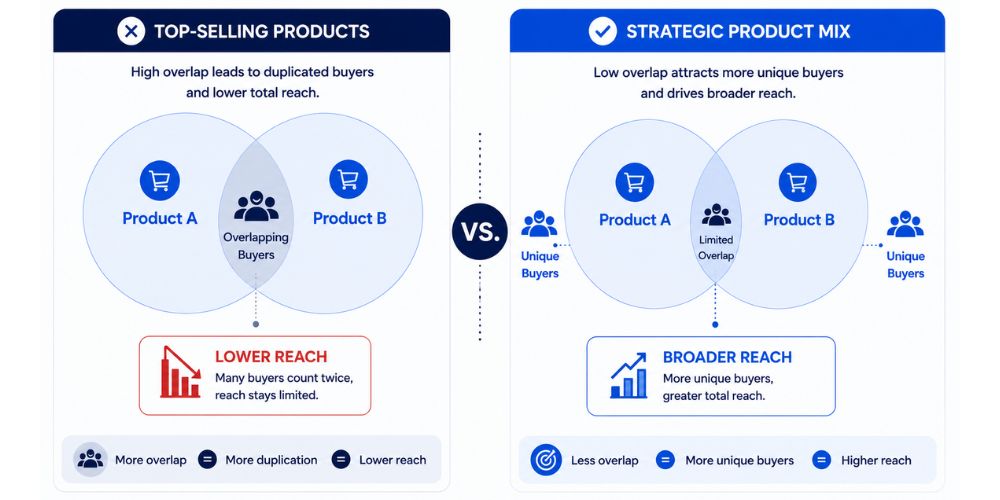
Many companies assume their best-selling products automatically create the strongest portfolio. In reality, product lines often compete against themselves without leadership realizing it.
Two products may attract nearly the same buyers while entirely different customer segments remain underserved. The result is wasted shelf space, overlapping demand, and missed market reach.
TURF analysis helps businesses identify which combination of products, features, or messages actually reaches the largest unique audience.
Why Product Popularity Alone Can Be Misleading
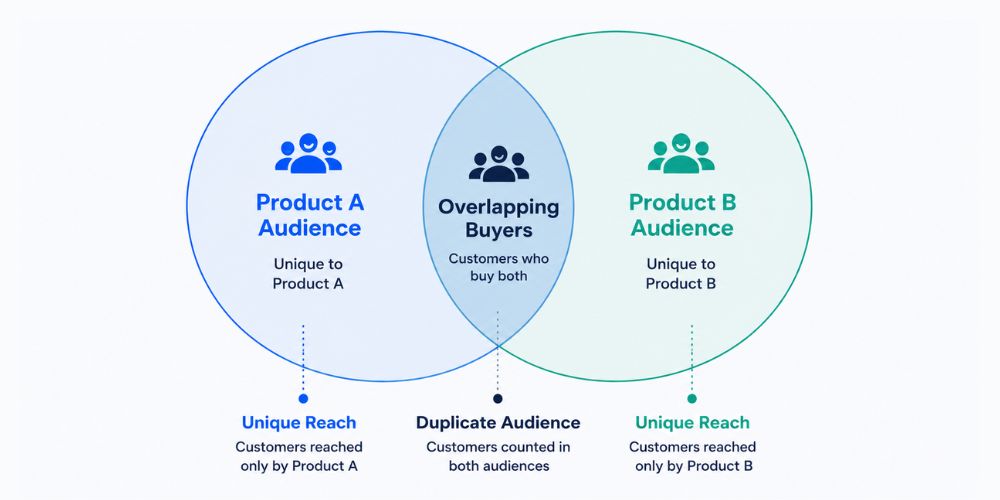
TURF stands for total unduplicated reach and frequency. It measures how well a combination of products, features, or messages reaches unique customers without unnecessary overlap.
Traditional research measures interest in products individually. TURF measures how well a combination of products reaches unique customers without unnecessary overlap.
Individual product popularity does not always translate into broader market reach. If Product A reaches 40% of people and Product B 35%, you may assume that your reach will be 75%.
However, if Product B reaches primarily the same people as Product A, your actual unduplicated reach may be 48%.
How TURF Analysis Works: Step by Step
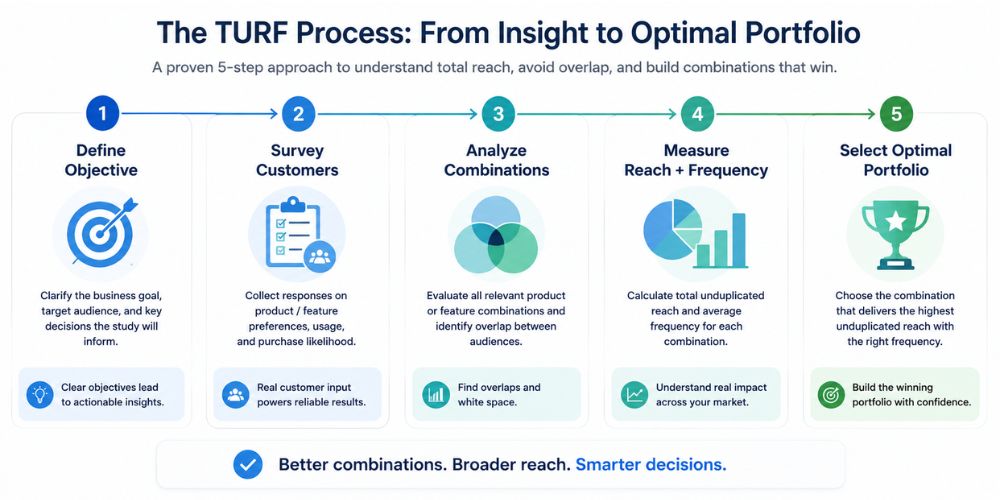
Step 1: Define What You Are Optimizing
The TURF method can be used in products, product versions, flavors, features, communication lines, or channels. Before you conduct the analysis, make sure that you clearly define the target and the meaning of “reach” for your problem.
For example, do you want to identify the best four SKUs to allocate to a restricted shelf? Or perhaps the optimal set of features for an innovative product line? Or the best three messages to promote in a communication line?
Conjoint studies are frequently used before TURF to estimate customer preferences across features and product configurations.
Step 2: Survey Your Target Market
TURF analysis assumes you have preference or purchase intent information about each of your options from a statistically reliable representation of your target customer base. Typically, this means showing each product and asking consumers whether they would buy, try, or accept the offer. In many studies, that preference data comes from MaxDiff or conjoint analysis.
Your choice of threshold will affect the accuracy of your TURF model. If you select “definitely buy” versus “would consider buying,” you will get a more conservative estimation of reach. Be sure your threshold is appropriate to your situation.
Step 3: Run the Reach Calculations
Given the data, the analysis is done through an iterative process, trying out all possible combinations of your choices and determining their unduplicated reach.
When dealing with just a few options, like six products, this process is straightforward. With more options, there will be many combinations, too many to manually evaluate.
These cases call for computing power to do the calculations, with results sorted according to the unduplicated reach of all combinations.
Step 4: Layer in Frequency
Reach alone will tell you how many unique individuals the combo reaches. Frequency, on the other hand, provides an additional dimension regarding how many times the average reached individual will interact with one or more options in the combo.
Even if the combo’s reach is slightly reduced but its frequency is substantially increased, it can still be considered more valuable in your context. A subscription-based service places high value on frequency. One-off purchases emphasize reach.
A more advanced application of TURF can also factor in elements of economic opportunity, such as brand affinity, category spend, income, or behaviors, as additional weights so that the results reflect the best combinations for the highest-opportunity groups. On the other hand, item-level weights can be applied that reflect some sort of “cost” so that the bundles can also reflect a higher likelihood to be more profitable. The Analytics Team can help you find the most valuable TURF analysis to run given your study objectives.
Step 5: Identify the Optimal Combination and Make the Decision
The last step involves converting the output generated into an action or a decision about products or portfolios. TURF analysis produces a ranked list of product combinations based on unduplicated reach.
An interactive TURF Tool can help you find the best combinations. A tool like this allows for quick exploration of the results between different subgroups, using different weights or rules, and having different inclusion rules for items, such as exclude or require. The Analytics Team offers an interactive tool as one of the TURF solutions.
How a Company Increased Market Reach by 13 Percentage Points
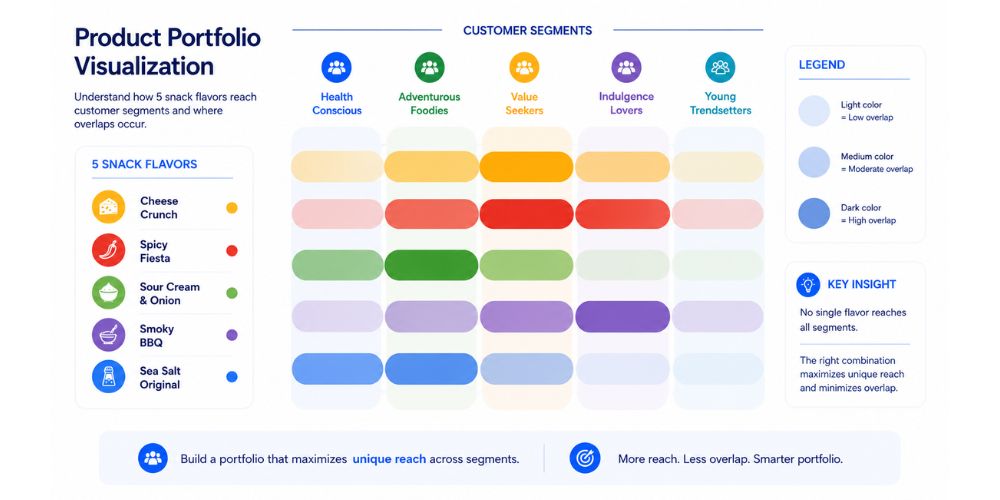
A regional snack manufacturer plans to conduct a retail reset and has five slots available for SKU placement. There are a total of twelve flavors in its current portfolio, and the company wishes to determine which flavors should be selected to attract the greatest number of consumers.
It surveys 600 category buyers and asks them which flavors they would consider purchasing. It sets the criteria as “definitely buy.”
On paper, the company’s five most popular flavors looked like the safest choice. The problem was that many of those flavors appealed to the same customers, limiting the portfolio’s total reach.
| Combination | Flavors Included | Unduplicated Reach |
| Top 5 by individual popularity | Original, BBQ, Ranch, Cheddar, Honey | 61% |
| TURF-optimized 5 | Original, BBQ, Jalapeño, Sea Salt, Sweet Chili | 74% |
| TURF-optimized 4 + 1 new | Original, BBQ, Jalapeño, Sea Salt, Sriracha Lime | 76% |
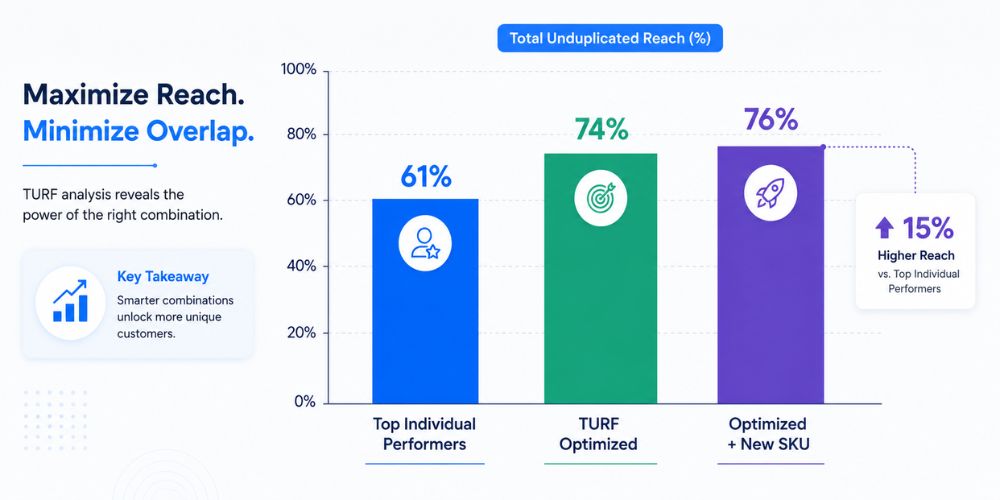
The top five flavors on an individual basis account for 61% of the market. The optimized combination with the use of TURF accounts for 74%, gaining 13 additional percentage points just by replacing flavors that appealed to similar customers with those targeting different segments.
The strongest individual products did not create the strongest portfolio. That is the practical value of TURF. The best individual performers are not always the best portfolio combination.
Where TURF Analysis Gets Used
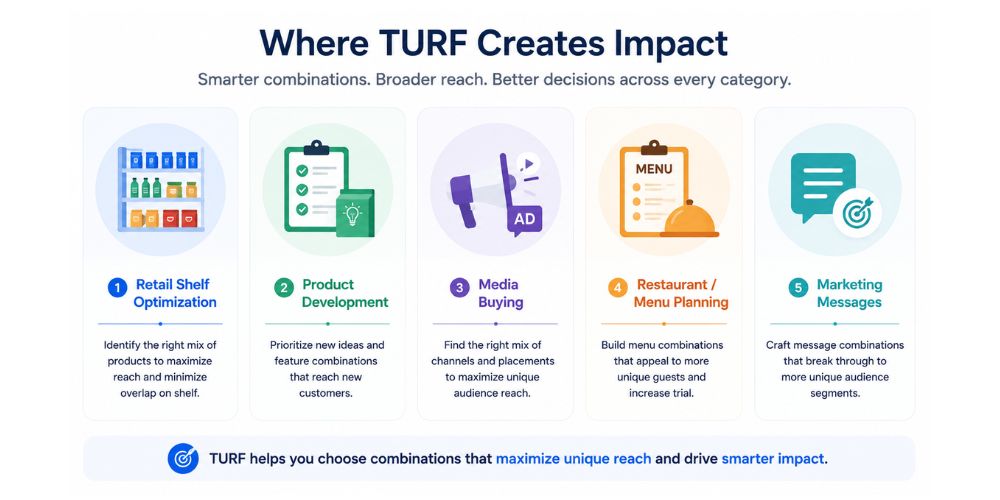
Portfolio Management
Companies often face shelf-space and budget limitations. TURF helps identify which product combinations maximize unique customer reach without unnecessary overlap.
Product Development
TURF analysis helps teams determine which combination of features or product concepts appeals to the broadest market before launch.
Media and Advertising Strategy
Marketing teams use TURF to identify the best mix of channels or messaging strategies for reaching the largest unique audience efficiently.
Menu and Assortment Planning
Restaurants, retailers, and subscription services use TURF to optimize menu offerings and reduce duplication across customer preferences.
Message Testing
TURF helps marketers determine which combination of campaign messages reaches the widest audience without repeating the same appeal.
Tools Used to Run TURF Analysis
The value of TURF analysis depends less on software and more on the quality of the survey data being used.
| Tool | Best For | Notes | Skill Level |
| SPSS | Large datasets, research firms | Requires statistical knowledge | Advanced |
| R | Custom analysis, flexible outputs | Open source, steep learning curve | Advanced |
| Excel with macros | Small option sets | Manual, limited scalability | Intermediate |
| Qualtrics | Survey integration + basic TURF | Built-in for smaller analyses | Beginner |
| Lighthouse Studio (Sawtooth) | Advanced conjoint + TURF | Industry standard for complex work | Advanced |
For any business application, the use of tools is not so critical; however, what is important is the quality of data used to generate TURF results. Many organizations also struggle with whether advanced analytics projects should be managed internally or with specialized research partners. The effectiveness of the survey depends upon its structure as well as the respondents involved in it.
Limitations to Know Before You Run TURF
TURF gives equal weight to all responses. It doesn’t consider the potential for some customer groups to be more profitable than others. A combination that gets to 70% of customers becomes irrelevant if it is failing to get through to your most profitable customer group.
It doesn’t capture substitute behaviors. TURF identifies who will use a combination, but not how many of them would still do so if one product from that combination were not offered. Conjoint analysis would be more appropriate in this case.
It relies on the survey methodology used. If the alternatives offered in the questionnaire are unrealistic or the acceptable rate varies for each respondent, the results become meaningless.
It doesn’t account for cannibalization. Reach alone does not guarantee profitability. The TURF model reduces overlap in coverage, but it doesn’t provide insights into cannibalization. This must be estimated separately.
Even well-structured TURF studies can produce misleading conclusions when the wrong assumptions or survey methods are used.
Common Mistakes in TURF Analysis
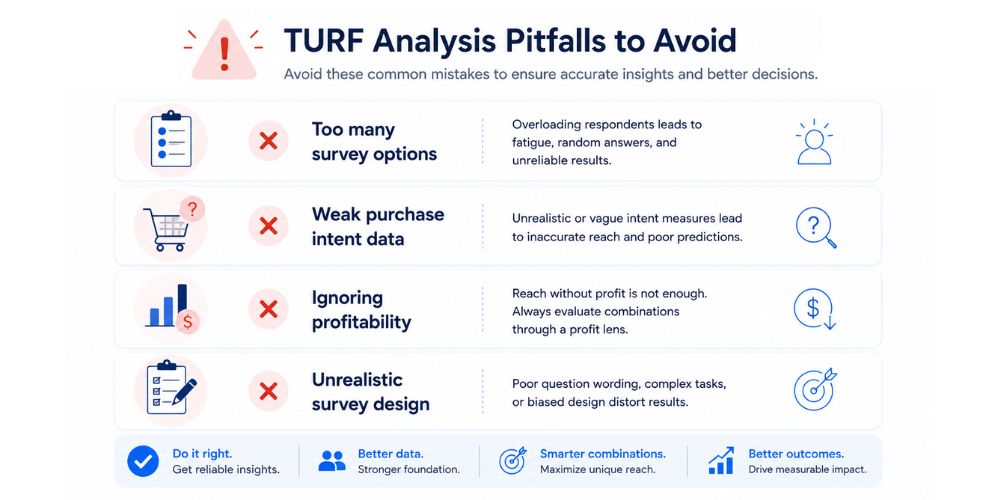
Testing Too Many Options at Once
Fatigue is created when people are asked fifteen or twenty options in one go; the ratings become inaccurate because of this. Limit surveys to a manageable number of options to reduce respondent fatigue and improve data quality.
Using Awareness Instead of Purchase Intent
People can have knowledge about a product but not necessarily purchase it. TURF analysis based on such awareness data would be grossly exaggerated.
Ignoring Strategic Constraints
Not always will the optimal TURF combination be the correct business decision. Margins, cost, brand compatibility, and channel demands must all be considered in addition to what the numbers tell us.
Treating the Output as Final
This is an input in your decision-making process, but it should not be used to make that decision. It should just help inform it.
Turn Portfolio Decisions Into a Competitive Advantage
Product portfolio decisions directly affect market reach, shelf efficiency, and long-term growth. Without the right analysis, businesses often invest in products, features, or messaging strategies that compete for the same audience instead of expanding overall reach.
TURF analysis helps organizations identify the combinations that maximize unique customer coverage while reducing unnecessary overlap.
The Analytics Team provides custom TURF analysis services for product strategy, retail resets, assortment planning, message testing, and portfolio optimization. We help businesses make product and marketing decisions using data-driven insights instead of assumptions.